Orange and Blue disks have a common tangent line IK intersecting DB at A. The red circle has chord DB, and tangents AF and AG. Show that the chord FG , the line DB, and two of the common tangents (LM and OP) have H in common.
Common tangents II
Orange and Blue disks have a common tangent line IK intersecting DB at A. The red circle has chord DB, and tangents AF and AG. Show that the chord FG , the line DB, and two of the common tangents (LM and OP) have H in common.
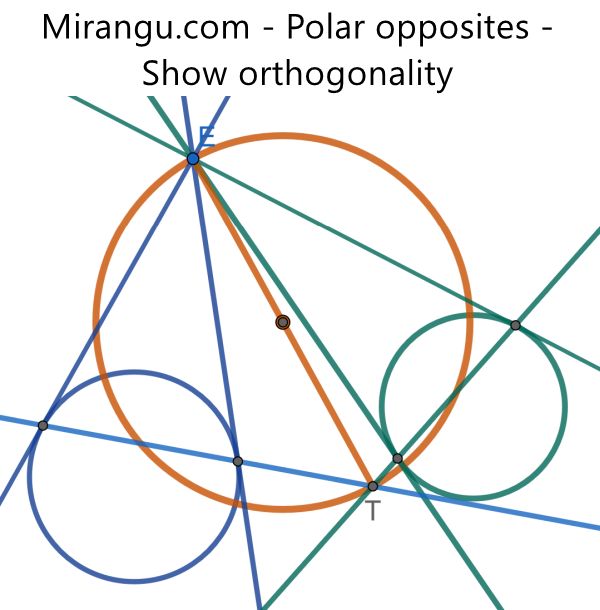
The polar lines for a point E with respect to the blue and green circles intersect at a point T. Show that the orange circle with diameter ET intersects the other circles orthogonally.
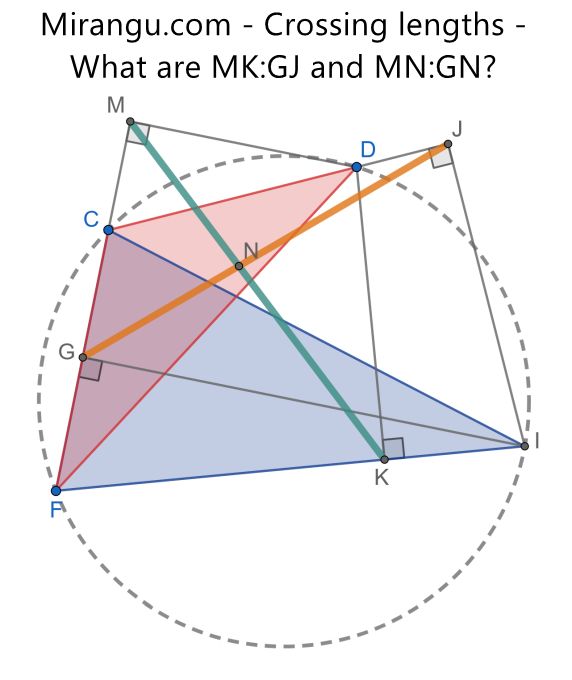
A cyclic quadrilateral (CDIF), where we form two segments: MK (green) with DM perp to FC and DK perp to FI; GJ (orange), with IG perp to FC and IJ perp to CD. What is the ratio MK:GJ ? What about MN:GN?
A regular pentagon and two squares. Prove that the four purple vertices are concyclic.
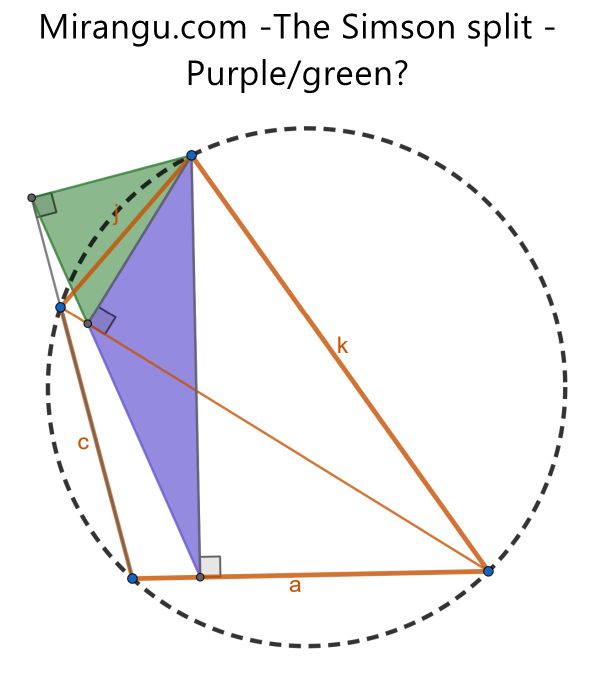
A cyclic quadrilateral has side lengths a, c, j, and k. Three segments drop perpendicularly to two sides and one diagonal of the quad, forming the green and purple triangles between them. What is the ratio purple/green, in terms of a, c, j, k?
A triangle and its circumcircle. What is red : blue?
Three lawnmowers set off from the three vertices of a triangular field moving clockwise around the boundary. When they reach the next vertex they each take a turn inwards (ie veering to the right of the already cut path ahead) by alpha degrees and then, proceeding in a straight line, all three meet up at a point D inside the field. (They might not all get there at the same time.)
Show that if instead they started out going counter-clockwise and veered left by exactly the same angle alpha at the next vertex, then they would also arrive at a common meeting point H (generally different from D).
Puzzle author: David Odell.
The orange and blue segment lengths are fixed, the pivot point A and the purple line are fixed, and D slides up and down a fixed green line. Show that the intersection point G does not move.
Three equilateral triangles enclose three interior triangles that share a common angle size α. The outer triangles have areas s1, s2, and s3, the inner have areas t1, t2, t3. Express the ratio t1: t2: t3 in terms of s1, s2, s3.
Show that the red-blue line is perpendicular to the base line.
Improve your mental health with our new book “Vitamin G, 100 wholesome geometry puzzles”.
Order now